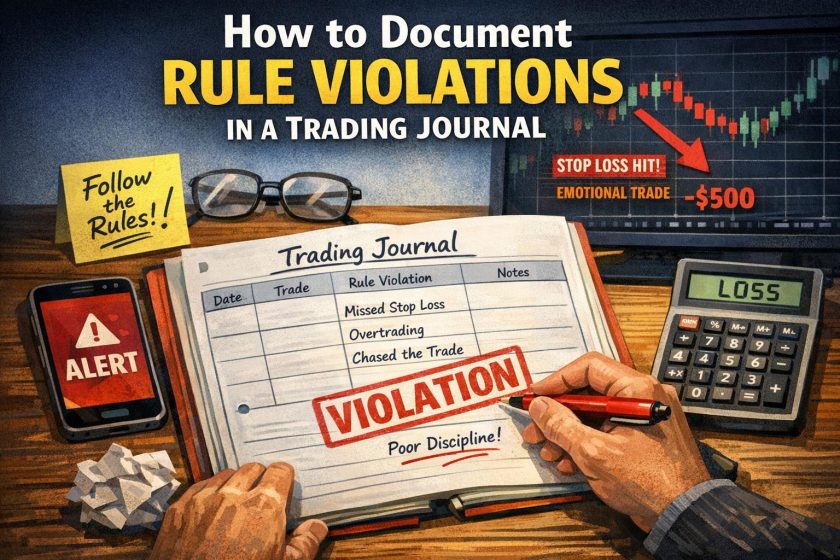
Understanding the Importance of Documenting Rule Violations
Maintaining a trading journal is a foundational practice for individuals engaged in financial markets. While many traders document entries, exits, and profits or losses, fewer pay sufficient attention to recording rule violations. A rule violation occurs when a trader deviates from a predefined trading plan, whether by entering a position prematurely, adjusting stop-loss levels without justification, overleveraging, or ignoring risk parameters. Documenting these deviations is not merely an administrative task; it is a structured method for improving performance, strengthening discipline, and reinforcing accountability.
A trading plan represents a framework built on testing, research, and personal risk tolerance. When traders disregard their own rules, they undermine the statistical foundation of their strategy. Markets are uncertain by nature, and even well-designed systems encounter losses. However, if losses stem from inconsistency rather than strategy performance, improvement becomes difficult to measure. Documenting rule violations helps isolate performance issues related to execution from those related to strategy design.
The Role of Structure in Trading Performance
Every trading system relies on consistency. Strategies are typically developed using historical data, probability considerations, and defined risk parameters. When rules are applied consistently, a trader can evaluate outcomes objectively over time. If rules are violated randomly or repeatedly, the resulting data becomes unreliable.
For example, a trader who modifies profit targets impulsively or cancels stop-loss orders during volatile conditions introduces variability that cannot be attributed to the original strategy. Without documentation, it becomes difficult to determine whether disappointing results stem from flaws in the system or from inconsistent implementation. Recording violations ensures transparency in performance evaluation.
Structure also supports decision-making under pressure. In fast-moving markets, cognitive overload may impair judgment. By documenting violations, traders gain insights into situations where structure breaks down. They can then adapt their processes to minimize similar lapses in the future, such as reducing position sizes during volatility or limiting the number of simultaneous trades.
Why Document Rule Violations?
Documenting rule violations serves multiple practical purposes. First, it creates a record of deviations that might otherwise be overlooked. Many traders remember significant losses but forget minor adjustments that cumulatively affect performance. Written documentation preserves objective details that memory alone cannot reliably retain.
Second, documentation promotes self-awareness. Recording deviations requires acknowledging that a rule was broken, which reinforces accountability. When the act of violating a rule is followed by deliberate documentation, the process itself introduces friction. This friction may reduce habitual or impulsive deviations over time.
Third, documenting violations allows traders to distinguish between necessary flexibility and harmful inconsistency. Not all deviations are inherently negative. Occasionally, market conditions justify adaptive decisions. However, distinguishing between a reasoned adjustment and an impulsive reaction requires deliberate analysis. Written records facilitate that evaluation.
Types of Common Rule Violations
Although individual trading styles differ, certain categories of rule violations appear frequently. One common example is entering trades without meeting all predefined criteria. A setup may be partially formed, but impatience can lead to premature execution. Another example involves altering risk parameters mid-trade, such as widening stop-loss levels to avoid realizing a loss.
Overtrading is another form of violation. Traders may exceed daily or weekly trade limits defined in their plans. This often occurs after a sequence of losses or missed opportunities. Similarly, deviating from position-sizing guidelines can distort expected risk-reward ratios and compromise capital preservation principles.
Failure to exit according to rules also constitutes a violation. Holding positions longer than intended due to speculation or closing them prematurely out of concern about market fluctuations disrupts the statistical consistency of the strategy. Recognizing and documenting these patterns clarifies how execution gaps influence performance.
How to Record Rule Violations Effectively
Effective documentation requires more than noting that a mistake occurred. A systematic approach ensures that records generate meaningful insights rather than fragmented observations. The documentation process should align with the structure of the trading plan to allow direct comparison between intended and actual behavior.
Detailed Description of the Violation
Each entry should begin with a clear explanation of the violated rule. The description should specify what the rule required and how the actual action differed. Identifying the context provides additional value. Details may include the financial instrument traded, time frame, market conditions, and any relevant indicators influencing the decision.
Precision enhances analytical usefulness. For instance, rather than writing “entered too early,” a more informative record might note that the trade was placed before confirmation from a required technical indicator. This clarity facilitates measurable improvement.
Analyze the Cause
Understanding the cause of a violation is essential for preventing recurrence. Causes may stem from internal factors such as fatigue, distraction, impatience, or overconfidence. External factors, including heightened volatility or unexpected news events, may also contribute.
Distinguishing between emotional impulses and structural weaknesses in the trading plan helps prioritize corrective measures. If violations frequently occur during specific times of day, schedule adjustments may be necessary. If repeated deviations arise from unclear rules, refining the plan improves execution consistency.
Impact Assessment
Evaluating the consequences of each violation connects behavior to measurable outcomes. Impact assessment involves reviewing both financial and procedural effects. Financial analysis may include calculating additional losses or reduced gains attributed directly to the deviation. Procedural analysis considers whether the violation disrupted other trades or created cascading errors.
Quantifying impact provides perspective. Some violations may be minor with negligible performance influence, while others significantly affect account equity. Prioritizing high-impact behaviors allows more targeted improvement efforts.
Reflection and Action Plan
Following analysis, the next step is forming a corrective action plan. Reflection should focus on practical improvements rather than generalized regret. Solutions might include adjusting daily trade limits, implementing predefined alerts, revising position-sizing calculators, or incorporating scheduled breaks to minimize fatigue-related errors.
Recording these planned actions transforms the journal from a passive record into an active performance management tool. Subsequent reviews can evaluate whether corrective measures reduced similar violations over time.
The Psychological Dimensions of Rule Violations
Trading performance is influenced not only by market knowledge but also by psychological stability. Rule violations often reveal underlying cognitive biases or emotional responses. Common influences include confirmation bias, fear of missing out, loss aversion, and recency bias. By documenting each deviation, traders can detect recurring psychological triggers.
Patterns may emerge indicating that violations cluster after a sequence of winning trades or during drawdowns. For example, a trader may increase position size after several profitable trades, believing short-term outcomes reflect improved predictive skill. Recognizing this pattern enables the trader to implement safeguards, such as fixed position-size limits regardless of recent performance.
Documenting emotional state at the time of the violation enhances insight. Briefly noting whether the decision occurred during stress, time pressure, or external distraction provides valuable qualitative context for quantitative outcomes.
Utilizing Technology to Streamline Documentation
Technology can significantly improve the efficiency and depth of documentation. Spreadsheet programs, specialized trading journal software, and integrated brokerage analytics platforms allow structured data entry and automated calculations. Many systems permit tagging trades with custom labels, including identifiers for different types of rule violations.
Automated metrics such as expectancy, drawdown analysis, and performance breakdown by instrument or time frame provide insight into whether violations correlate with specific conditions. Visual analytics, such as charts comparing compliant trades against non-compliant trades, illustrate behavioral impact on profitability.
Digital systems also facilitate periodic review. Weekly or monthly summaries can highlight frequency trends, showing whether corrective actions are effective. Consistent categorization enables long-term tracking and objective evaluation of behavioral improvement.
Integrating Documentation Into a Regular Review Process
Documentation achieves full value only when paired with structured review. Establishing a dedicated schedule for analyzing journal entries ensures that violations receive systematic attention. Reviews may occur weekly to identify short-term patterns and monthly to evaluate broader trends.
During reviews, traders can categorize violations by type and frequency, comparing them against performance metrics. If a specific deviation repeatedly coincides with substantial losses, it becomes a priority for corrective action. Conversely, if certain adjustments consistently produce improved performance, traders may evaluate whether their rules require formal modification.
Review sessions should focus on data rather than isolated anecdotes. Evaluating at least several weeks of records reduces reliance on recent outcomes and supports statistically informed adjustments.
Balancing Flexibility and Discipline
A structured approach to trading does not eliminate the need for adaptive thinking. Markets evolve, and rigid adherence to outdated rules may hinder performance. However, documented violations differentiate between deliberate strategy refinement and impulsive improvisation.
If documented deviations consistently demonstrate positive outcomes under specific conditions, traders may formally revise their trading plans. The key distinction lies in intentional integration rather than spontaneous reaction. Documentation creates a transparent process for incorporating change while preserving discipline.
In this way, documenting rule violations supports both stability and evolution. It ensures that system improvements result from analysis rather than impulse.
Long-Term Performance Development Through Consistency
Long-term trading success depends heavily on consistent execution. Even profitable strategies may appear ineffective if applied inconsistently. Documented rule violations provide clarity about execution gaps that distort performance evaluation.
Over time, reduction in the frequency and severity of violations often correlates with improved stability in results. As behavioral execution aligns more closely with the strategy’s design, performance metrics more accurately reflect the strategy’s inherent statistical edge. This alignment strengthens confidence in data-driven decision-making.
Furthermore, consistent documentation establishes a professional standard. It transforms trading from an activity driven primarily by instinct into a structured performance discipline similar to other high-skill professions. The process encourages ongoing learning, methodical analysis, and measurable development.
Operational Benefits Beyond Financial Performance
While financial improvement is a primary objective, documentation of rule violations also enhances operational efficiency. Clear records reduce ambiguity in decision-making and promote efficient time allocation. Instead of repeatedly questioning why certain losses occurred, traders can consult documented patterns to identify causation quickly.
Comprehensive records are also valuable for those managing external capital or collaborating within trading teams. Transparent documentation demonstrates adherence to predefined risk frameworks and supports accountability in professional environments.
Additionally, long-term recordkeeping creates a reference archive for future strategy development. Historical patterns of violation may reveal behavioral tendencies that persist across different market cycles. Recognizing these tendencies enables proactive planning during periods of increased stress or volatility.
Conclusion
Documenting rule violations within a trading journal is an essential component of disciplined performance management. It distinguishes execution errors from strategic deficiencies, reinforces accountability, and supports structured learning. By recording detailed descriptions, analyzing causes, assessing impact, and implementing corrective action plans, traders build a comprehensive framework for continuous improvement.
Technology enhances this process by enabling efficient tracking and data-driven analysis, while regular review sessions transform information into practical refinements. Over time, consistent documentation reduces behavioral inconsistency and aligns trading activity with predefined strategic objectives.
Ultimately, the practice of documenting rule violations strengthens both analytical clarity and procedural discipline. It ensures that performance outcomes reflect deliberate strategy rather than avoidable deviation, creating a stable foundation for sustained participation in financial markets.